
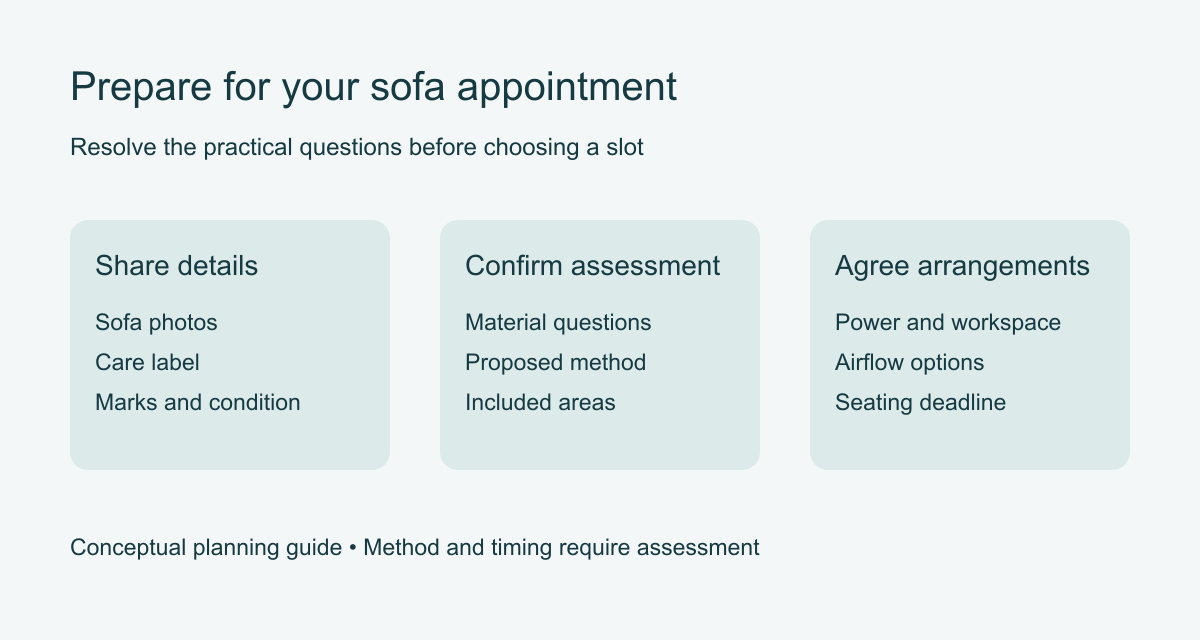
If you need your sofa ready for visitors, a rental handover or everyday family use, the key booking question is not simply when cleaning can start. It is whether the proposed method suits the upholstery and how you will manage the period before the sofa is ready to use again. Agree those details before committing to an appointment.
Cleanitize describes an on-site service that starts with checking the fabric type and care code. Its service information also identifies fabric, thickness, ventilation and humidity as drying considerations. That supports a practical approach: share the sofa details, ask how the material will be assessed, and discuss your actual deadline. A general drying estimate should not become a promise for your particular sofa.
Start with the fabric check, before choosing a cleaning method
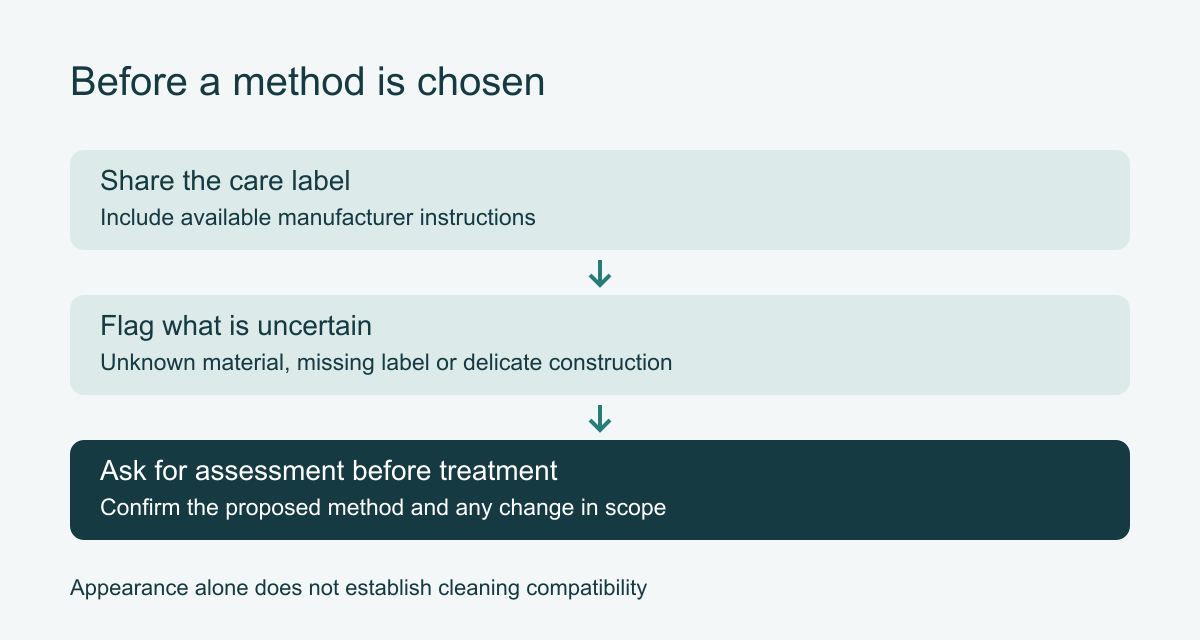
A sofa’s appearance is not enough to settle how it should be cleaned. Cleanitize’s upholstery page acknowledges that coated weaves and bonded leather can be difficult to distinguish, and that delicate or structured pieces need assessment before anything is applied. If you do not know the material, say so rather than selecting a method based on a similar-looking sofa online.
Find the care label if it is accessible and send a clear photograph with your enquiry. Include any manufacturer instructions you already have. The useful question is: ‘Does this label permit the method you are proposing, and what will you check before starting?’ Do not interpret a missing label as permission to use steam or extraction. Ask what assessment is possible when the label cannot be found.
The Cleanitize fabric sofa cleaning service describes different handling for natural weaves, pile fabrics and synthetic upholstery. Those categories are useful starting points for a conversation, rather than confirmation that every sofa within a category can receive the same treatment. The care instructions and assessment of the actual piece take priority over a broad fabric description.
Also flag loose covers, buttoned backs, antique frames or other construction details that might affect access or treatment. Cleanitize specifically identifies these as pieces to assess first, with some better suited to low-moisture cleaning. A removable cover is therefore a detail to disclose, not an instruction to remove or wash it before the appointment.
Understand what the proposed service involves
Cleanitize explains that its upholstery ‘steam cleaning’ refers more precisely to hot-water extraction. Its description includes pre-treatment, application of heated solution, extraction, moisture control and finishing. For a buyer, the useful distinction is between a named service and the steps proposed for your sofa. Ask the provider to explain those steps in relation to the label and condition you have shared.
The sofa and upholstery cleaning method overview also distinguishes extraction from dry or low-moisture approaches. It says the method is chosen after checking the care code. If a provider recommends a different approach after inspecting the sofa, ask what prompted the change and how it affects the agreed scope and drying plan before work proceeds.
Clarify the areas included as well. Cleanitize’s fabric service description mentions cushions on both sides, arms, corners and seams. Tell the team whether your enquiry concerns the whole sofa or particular marks, and ask which parts of your specific furniture can be accessed. This keeps a quote for a general clean from being mistaken for an agreement about every concealed or fixed component.
Plan around drying conditions, not a guaranteed clock
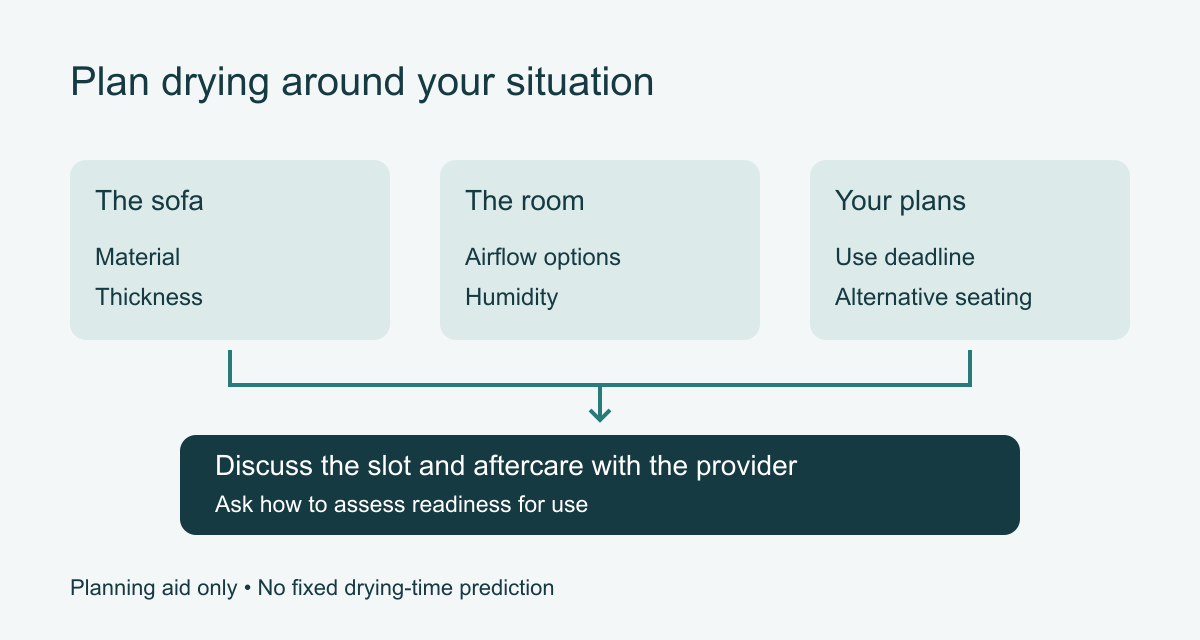
The service guidance connect drying with material, thickness, airflow and humidity. They also mention fans or air-conditioning as ways to support drying. This does not establish a fixed completion time for an individual appointment. Before booking, explain both when cleaning can happen and when you need the seating available again.
For example, ‘We have guests arriving after the appointment’ is less useful than stating the actual event and asking whether the proposed slot leaves an appropriate margin. If the sofa is essential seating and there is no alternative, discuss that constraint first. Where the provider cannot confidently reconcile the appointment with your deadline, consider another date rather than treating an estimate as a guarantee.
Describe the room honestly. Let the team know what airflow options are available and whether you can run a fan or air-conditioning after the visit. Ask how they want airflow arranged for your sofa. Cleanitize describes finishing and airflow as part of encouraging even drying, so this is a practical handover question rather than a reason to improvise a new treatment yourself.
Ask how you should judge readiness for use and what to do if part of the sofa still feels damp. Do not assume that a surface impression settles the condition of every cushion or thicker section. The source information does not provide a universal home test for complete dryness, so obtain instructions for your piece instead of relying on a generic checklist found elsewhere.
Arrange alternative seating while the sofa is unavailable. Cleanitize advises keeping children and pets off the furniture until it is dry, noting that damp upholstery can pick up fresh dirt. Treat this as an aftercare and scheduling point; it does not establish any medical benefit or universal assurance about cleaning products.
Use this checklist before agreeing the appointment
The most useful comparison is between what you already know and what still needs confirmation. Send the known details together so the provider can respond to the whole situation. The table below separates preparation you can do now from decisions that need the team’s input.
| Decision | Prepare or disclose | Question to confirm |
|---|---|---|
| Material and method | Care-label photo, known material and any uncertainty | What assessment is needed before you choose the method? |
| Construction and scope | Sofa layout, cushion arrangement and delicate details | Which areas are included and accessible on this piece? |
| Marks and expectations | Close-up photos, known cause and approximate history | Which marks may remain after treatment? |
| Drying arrangements | Available airflow and when seating is needed | Is this appointment appropriate for our deadline? |
| On-site access | Location of a power point and room around the sofa | What needs moving before you arrive? |
| Quote and availability | Seat count, condition, area and preferred date | What is included, and what still requires inspection? |
Send photographs that help the team assess the job
Cleanitize’s contact page invites photographs for an estimate. A practical enquiry can include a whole-sofa view to show the layout, close-ups of the problem areas and the care label. Add the seat count and tell the team if the sofa has a sectional arrangement or recliner features. These details make the request more specific without requiring you to identify the cleaning method yourself.
Describe stains separately where you can: what caused the mark, roughly when it happened and whether you know of any previous treatment. If the cause is unknown, write ‘unknown’. Cleanitize states that older, set-in or dye-based stains may not fully lift. Ask for realistic expectations before booking, particularly when one visible mark is the main reason you want the appointment.
Do not treat the website’s illustrative cleaning examples as a forecast for your own upholstery. The fabric page labels them illustrative and says results vary with the fabric, stain and time the mark has had to set. They explain the kinds of issues discussed by the service, but they do not establish a first-hand outcome for your sofa.
Prepare the room without pre-treating the sofa
Cleanitize says its equipment comes to the home or office and requires access to a power point and some room to work around the furniture. Before arrival, clear personal belongings from the seating and identify the accessible socket. Ask whether nearby items need moving, especially if the sofa sits tightly between other furniture.
Confirm any expectation about moving the sofa or taking off covers rather than doing it automatically. The published service guidance do not establish a universal furniture-moving service or a requirement for customers to dismantle seating. A short question about access is more useful than making assumptions about what the team will move or which parts should be detached.
Preparation also does not require experimenting with a new stain treatment. Give the provider the information needed to assess the mark and ask whether anything should be done before arrival. Where the care instructions or proposed treatment are unresolved, keep that question open until the provider responds. The purpose of preparation is to improve assessment and access, not to make an unsupported compatibility decision at home.
Finish the booking with a clear handover plan
Use the Cleanitize contact and quote page to send the sofa information, your area and preferred appointment date. The page offers WhatsApp, telephone and email contact and says availability will be confirmed for your area. A preferred slot in an enquiry should therefore remain a request until the team confirms it.
A concise message could read: ‘I have a fabric sofa with this seat layout. Attached are the care label and photos of the marks. I am unsure of the exact material. We need the seating available for this occasion, and these are our airflow options. Please advise on assessment, included areas, preparation and whether the proposed appointment suits that deadline.’
Before the team leaves, ask what was assessed, what aftercare applies, when to check the sofa again and how to raise a concern about a remaining mark or damp area. That closes the loop between booking and use. The best preparation is a shared understanding of the material, scope and drying arrangements, with uncertainty resolved through assessment rather than a promised result.