
Curtain Steam Cleaning vs Dry Cleaning: Which Should You Choose?
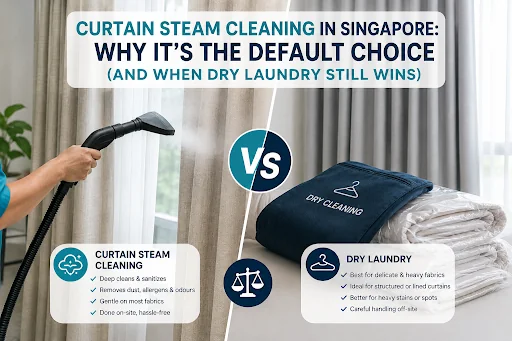
Curtains can be cleaned two ways in Singapore: on-site steam cleaning with the curtains still hanging, or take-down dry cleaning where they are removed, cleaned and rehung. Both are legitimate. They suit different situations, and paying for the deeper one when you do not need it is a common and avoidable expense. The short version: steam for a routine refresh, dry cleaning when there are visible marks or the curtains have never been done. The detail below covers how to tell which case you are in. Steam or Dry Cleaning: The Comparison On-site steam cleaning Take-down dry cleaning Curtains come down No Yes — removed and rehung Best for Routine refresh, dust, light odours Set-in stains, heavy soiling, never-cleaned curtains Time without curtains None Several days Dust and dust mites Effective Effective Visible stains Limited Best option Heavy blackout linings Surface refresh only Full clean Typical frequency Every 6–12 months Every 1–2 years Most households end up alternating: steam cleaning as the regular refresh, with a full dry clean occasionally when the curtains need more than a freshen. Both are covered on our curtain cleaning page. What Actually Happens During Curtain Steam Cleaning? Steam cleaning works on curtains exactly where they hang, without taking them down first. High-temperature steam is applied directly to the fabric, loosening dust and dirt trapped in the weave and killing dust mites and allergens in the process, without relying on chemical detergents to do the work. Because the curtains stay up throughout, there’s no gap in privacy or light control while cleaning happens, and no separate re-hanging step afterward. For most households, that alone is the practical difference between steam cleaning feeling like a quick refresh and a full laundry process feeling like a bigger undertaking than it needs to be. Why Is Steam Cleaning the Right Call for Most Homes in Singapore? Singapore’s climate is part of the reason steam cleaning fits so well here. Humidity encourages dust mites, and curtains near windows pick up outdoor dust and pollution more than most other fabric in the home. Steam addresses exactly that kind of buildup directly, rather than needing a full wash cycle to reach it. Most curtains in Singapore homes are also made from polyester or cotton-blend fabric, which responds well to steam without the shrinkage or colour risk that heavier or more delicate materials can face. That combination, common fabric plus common buildup, is why steam cleaning ends up being the right fit for most households rather than the exception. It also tends to suit homes with children or pets particularly well, since it works without leaving chemical residue behind on fabric that people brush past every day. When Does Dry Cleaning Still Make More Sense Than Steam? Steam cleaning isn’t the answer for every curtain, and it helps to know where the line actually sits. Heavier or more delicate fabrics, such as velvet, silk, or curtains with thick blackout lining, are generally better suited to a full curtain dry cleaning process, since these materials can react differently to steam than a standard polyester blend does. Visible stains are the other clear signal. Steam is built for dust, mites, and general buildup rather than for lifting a set-in mark, so a curtain with an actual stain usually needs the more thorough treatment a take-down laundry process provides. The same applies to curtains that haven’t been properly cleaned in a long time, where the buildup has gone beyond what a surface-level steam treatment is designed to reach. How Often Should Curtains Actually Be Steam Cleaned? There isn’t a single fixed schedule that suits every home, since it depends more on what’s happening in the room than on the calendar. Curtains in a room facing a busy road, or in a household with pets or smokers, accumulate dust and odour faster than curtains in a quieter interior room that rarely gets direct airflow from outside. As a general guide, once or twice a year tends to keep most homes ahead of visible buildup, with busier or more exposed rooms benefiting from cleaning closer to the more frequent end of that range. Waiting until curtains visibly look dull or smell noticeably stale usually means the buildup has already gone further than a single steam session would ideally need to address. Can You Tell Just by Looking at Your Curtains Which One You Need? Most of the time, yes. If your curtains look and smell fine but probably haven’t been deep cleaned in a while, that’s dust and allergen buildup, which is squarely what steam cleaning is for. If there’s a visible stain, a lingering smell that doesn’t air out, or the fabric itself is heavy, lined, or delicate, that’s a signal to lean toward dry cleaning instead. The cases that are genuinely hard to call from a distance are usually old curtains where dust has built up alongside light staining, or fabric you’re simply unsure how to identify. In those situations, it’s worth having someone assess the fabric directly rather than guessing and picking the wrong process, since the wrong treatment can occasionally do more harm than leaving the curtains as they are. What Should You Expect on the Day of a Steam Cleaning Appointment? The process is meant to be straightforward from the first message onward. You describe what needs cleaning, a suitable time slot gets confirmed, and the cleaning itself happens on-site at your home or office without you needing to take anything down beforehand. Afterward, the curtains are simply left to settle back into place, refreshed rather than replaced. That simplicity is really the point. A process that requires no dismantling and no separate re-hanging step afterward is a large part of why steam cleaning remains the practical first choice for most Singapore homes, rather than something reserved for a deep annual clean. So Which One Does Your Home Actually Need? For the majority of curtains in Singapore homes, curtain steam cleaning is the more practical starting point: no take-down, no chemical