
You vacuum every week. You still see a fine layer of dust settle back onto your carpet within days, and you or your family keep sneezing at home for no obvious reason. If this sounds familiar, the problem usually isn’t how often you vacuum it’s what’s living deep inside the carpet fibres that a regular vacuum cleaner can’t reach.
In Singapore’s warm, humid climate, carpets are one of the easiest places in the home for dust mites and allergens to build up and one of the hardest to keep genuinely clean with surface cleaning alone. Here’s why it happens, and what actually fixes it.
Why Carpets Attract So Much Dust and Allergens
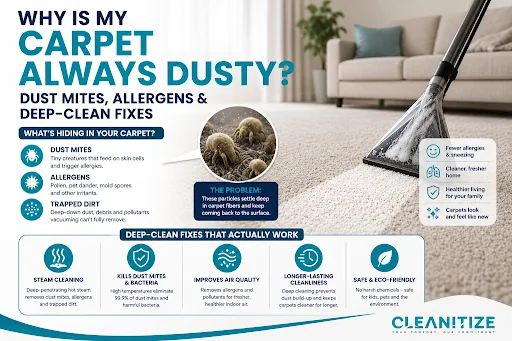
Carpet fibres act like a filter for your entire home. Every time someone walks across it, dust, skin cells, pollen, and pet dander already in the air settle into the fibres instead of staying airborne. Over time, this builds up deep within the pile well below the surface layer that a vacuum head actually touches.
The bigger issue is what feeds on that buildup. Dust mites are microscopic creatures that live on shed human skin cells, and they thrive in warm, humid conditions which describes most Singapore homes for much of the year. Carpets, along with mattresses and upholstery, are among their favourite environments because they offer both a steady food source and the moisture they need to survive.
Why Vacuuming Alone Isn’t Enough
Regular vacuuming is important, but it has real limits. Standard vacuums are designed to lift surface dirt and debris not the microscopic mite bodies, shed skin, and allergen particles embedded deep in the carpet pile. In fact, without a proper HEPA filter, some vacuums can push fine dust and allergens back out into the air rather than trapping them, which is part of why a room can feel dustier right after cleaning.
Dry vacuuming also does nothing to address the humidity mites depend on to survive. Since dust mites die off once humidity drops below roughly 50%, and Singapore’s ambient humidity regularly sits well above that, carpets here rarely get the dry conditions that would naturally keep mite populations down on their own.
The Role of Heat and Deep Extraction
This is where deep cleaning methods make the real difference. Heat is one of the most effective tools against dust mites steam cleaning doesn’t just lift embedded dirt out of the carpet fibres, it also uses heat to kill mites directly, rather than simply disturbing them the way dry vacuuming does.
Proper deep cleaning also physically extracts the allergen material — shed skin, mite waste, and trapped dust rather than just loosening it. That combination of heat and extraction is what addresses both sides of the problem: reducing the mite population and removing the allergen buildup that triggers sneezing, congestion, and skin irritation in sensitive household members.
Signs Your Carpet Needs More Than a Vacuum
A few signals suggest your carpet has moved past what routine vacuuming can handle:
- Dust seems to reappear on surfaces within a day or two of cleaning
- Household members experience more sneezing, itchy eyes, or congestion at home than elsewhere
- The carpet has a musty or stale smell, even after vacuuming
- It’s been more than six to twelve months since the carpet was last deep cleaned
- You have young children, pets, or family members with asthma or allergies spending significant time on the carpet
Any one of these on its own might not be a major concern, but together they usually point to allergen buildup that surface cleaning simply can’t reach.
How Often Should Carpets Be Deep Cleaned?
For most homes, a professional deep clean every six months strikes a reasonable balance frequent enough to keep allergen levels down, without being excessive for normal household use. Homes with pets, young children, or allergy-sensitive family members often benefit from a shorter interval, since these households tend to generate more of the organic material dust mites feed on.
Between professional cleans, regular HEPA-filter vacuuming and keeping indoor humidity in check will help slow the buildup but they’re a maintenance step, not a substitute for the deeper clean that actually resets the carpet.
Getting a Genuinely Deep Clean
If your carpet keeps looking and feeling dusty no matter how often you vacuum, the fix isn’t more frequent vacuuming it’s a cleaning method that actually reaches what’s embedded in the fibres. Carpet & rug deep cleaning uses steam and deep fibre extraction to lift out trapped dust, allergens, and dust mites that everyday vacuuming leaves behind, restoring both the look and the air quality of the room.
Cleanitize provides on-site carpet and rug deep cleaning across Singapore homes and offices, using methods suited to different fabrics and family needs, including households with children and pets. Get in touch with Cleanitize to book a deep clean and find out how much of a difference it makes.